
June 21st marks International Day of Yoga—an opportunity to recognize the powerful mental, emotional, and physical benefits of yoga.
At Wayspring, we know that recovery is a personal journey, and healing looks different for everyone. For some, yoga has been a life-saving part of that journey. We spoke with two of our own—Stephanie Coy and Shay Robb—who are both passionate yoga teachers and deeply involved in their local recovery communities. Here’s what they shared about how yoga can support those with a substance use disorder.
Yoga as a Pathway to Recovery — Stephanie Coy
“Yoga is what saved me when I was at my lowest.”

Stephanie Coy is an Engagement Specialist at Wayspring and a 200-hour Registered Yoga Teacher (RYT), with an additional 40-hour trauma-informed yoga certification. She’s currently completing her 500-hour certification and has been offering free yoga and meditation classes to the recovery community in Louisville, Kentucky for the past four years. For Stephanie, yoga is the primary pathway to her personal recovery.
“I worked the steps with my therapist many years ago, but I never had a sponsor, or a home group. When I realized the power yoga had in my life and how it can take you from ‘doing’ to just ‘being’, I knew that others could benefit in the same way that I did. I’ve even had several students who consider my yoga classes their own ‘home group’ now.”
Stephanie also organizes regular community events to spread awareness about the benefits of mindfulness practices on mental health.
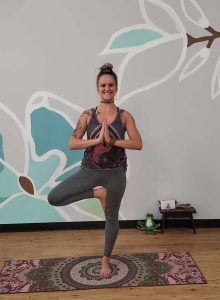
“When someone asks me, what yoga does for people in recovery, my answer is this: Yoga provides connection within, the connection of mind, body, and spirit we all so desperately need. Even bigger than that, yoga gives you freedom. As human beings, we are always thinking, especially as people in recovery. We try to ponder each decision, to do the next right thing, to admit our faults, to take personal inventory, to make amends. All these things are supposed to bring us healing, but how often do we take the time to just heal? To just be in the present moment? To just be still and let all the hard work we’ve put in be absorbed and take effect? Yoga is the freedom from all the thinking, all the decisions, all the pressure. Yoga gives you the pause, the space to just exist in this moment. Yoga lets all the magic happen.”
Yoga as Connection and Freedom — Shay Robb
“Yoga teaches us that everything we need is already within us and gives us the path to connect with that truth.”
 Shay Robb is also an Engagement Specialist at Wayspring and an E-RYT 200-hour teacher with Yoga Alliance, with firsthand experience of how yoga can transform lives—especially for those in their early stages of recovery.
“Over the years that I’ve been teaching yoga and meditation; I’ve met many students who have turned to yoga in their early recovery journey—one student even told me that yoga helps them to ‘process and regulate their emotions without the desire to use substances’.”
For Shay, yoga offers more than just mindfulness—it creates a space to be fully present and to connect with her true self.
“Yoga teaches us to be the calm in the storm, staying focused and at ease regardless of what is happening around us, or what is influencing our human existence.”
She adds, “Yoga truly teaches us non-attachment, giving us the tools needed to let go of what no longer serves us, which is very helpful for people dealing with substance use disorder, because yoga doesn’t judge; it only meets us where we are.”
“People say that the opposite of addiction is connection.” — Stephanie Coy
In both Stephanie and Shay’s stories, a clear theme emerges: connection. Whether it’s connection to self, to others, or to something bigger—yoga creates space for healing, growth, and connection with no judgement.